If you’ve ever spent time in cannabis or hemp extraction, you know that the trichome separator isn’t just another piece of equipment—it’s the backbone of consistent, high-quality product. For those who don’t work with these tiny, resin-rich glands, trichomes are the part of the plant that holds the cannabinoids, terpenes, and flavonoids that make your end product valuable. Without a separator that captures them efficiently, you’re wasting time, material, and money. But over the years, I’ve talked to hundreds of growers and extraction teams, and one question comes up again and again: “What kind of power source does an electric trichome separator actually need?” Trichome Separator
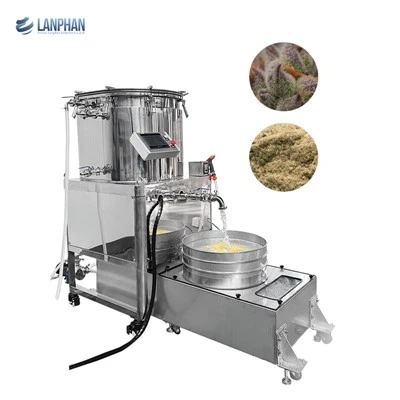
I’m not just some industry outsider writing about this—for the past seven years, I’ve run a trichome separator supply business, working side-by-side with small-scale craft growers and large commercial extraction facilities. I’ve seen teams use undersized generators that died mid-run, overcomplicated three-phase power that left their site without electricity for days, and even standard household outlets that could never keep up with their production goals. Today, I want to break this down, not with industry jargon, but with the real-world experience I’ve gained from solving power issues for hundreds of clients.
First, let’s get one thing straight: not all electric trichome separators are the same. A 2-foot tabletop unit for home craft use needs a completely different power source than a 10-foot industrial separator that processes 50 pounds of wet biomass every hour. That’s why the first step to figuring out your power source is knowing which separator model you’re running. When a new client reaches out to me, the first question I ask after they say “we need a separator” is “what’s your output per hour, and what’s your power access like at your site?” Too many people skip this and end up with equipment that either underperforms or doesn’t plug in where they need it.
Let’s start with small-scale units, which make up about 60% of my current client base. For tabletop or benchtop separators—usually used by craft growers with 5 to 50 pounds of biomass per week—standard single-phase 120V household power is usually enough. Wait, I know what you’re thinking: “Household power? That’s just a regular wall outlet.” Let me explain. Most small-scale electric separators have motors that range from ½ horsepower (HP) to 2 HP. A ½ HP motor pulls roughly 400 watts, and a 2 HP motor pulls around 1,500 watts. Standard 120V outlets in North America can handle up to 1,800 watts per circuit, so even a 2 HP unit will only max out two-thirds of that. But here’s a trick I tell my small-scale clients: always check if your outlet is on a dedicated circuit. If it’s shared with a fridge, a lighting system, or another tool, you’ll get voltage drop. I had a client in Oregon last year who tried running his 1.5 HP separator on an outlet shared with his grow lights, and every time he ran both, the lights dimmed and the separator slowed down. Once he moved it to a dedicated circuit, his trichome capture rate jumped 12%. That’s the kind of real-world detail no spec sheet tells you.
But what if you’re running off-grid, or your site doesn’t have reliable access to 120V power? A lot of small craft growers operate in rural areas, or use mobile grow sites, so portable power is a common need. For small-scale separators, a 2,000-watt pure sine wave generator is perfect. Not all generators are the same, though—you need a pure sine wave, not a standard inverter generator. Here’s why: electric separator motors are sensitive to dirty power. If you use a standard generator that produces modified sine wave, you’ll get voltage fluctuations that can overheat the motor or cause it to run inefficiently. I once had a client in Northern California who rented a cheap modified sine wave generator for a weekend harvest, and by Sunday morning, his separator’s motor burned out. Replacing that motor cost him more than a new generator, so now I always emphasize pure sine wave for off-grid small-scale use.
Now, let’s talk about the big players—commercial-scale separators, which handle 50+ pounds of biomass per hour, for full extraction facilities. These units aren’t tabletop; they’re large, heavy machines with motors ranging from 5 HP to 20 HP. Here, single-phase power won’t cut it. You need three-phase power. I hear this complaint all the time: “My building has 120V outlets, but the electrician says I need three-phase.” Let’s clarify the difference. Single-phase power delivers power in one waveform, which is fine for small motors, but three-phase delivers power in three overlapping waveforms. This makes it much more efficient for high-demand motors, reducing voltage drop, heat, and wear on the equipment. A 5 HP commercial separator on single-phase would pull around 5,000 watts, which would require two dedicated 120V circuits, but even then, the motor will run less efficiently. On three-phase, that same 5 HP motor runs smoother, uses less energy, and lasts longer. For a 20 HP commercial separator, we’re looking at 15,000 to 20,000 watts of power, so three-phase 240V or 480V is standard. Most commercial extraction facilities already have three-phase service installed, but I always recommend checking with your utility provider before buying a large separator. I once had a client in Colorado who didn’t do that, and when their utility showed up to install three-phase, they realized the line to their building was too small—costing them an extra $8,000 to upgrade. That’s a avoidable mistake.
Another power consideration I rarely see discussed: constant power vs. surge power. Every electric motor has a surge—when it starts up, it pulls two to three times its running wattage. For small-scale separators, that surge is manageable with a standard 2,000-watt pure sine generator: the surge will be around 1,800 watts, which is within the generator’s limit. For commercial units, though, the surge is a whole different story. A 10 HP motor will have a surge of around 15,000 to 20,000 watts. If your facility has a generator for backup, it needs to be rated for that surge. I had a large client in Michigan whose backup generator was rated for 12,000 watts; when the power went out during a storm, they tried running their 8 HP separator, and the generator couldn’t handle the surge, tripping the breaker. Now, all my commercial clients get a detailed surge calculation guide from me when they purchase a separator—small investment that saves thousands in downtime.
Also, don’t forget about power quality beyond just voltage and phase. I can’t tell you how many times I’ve seen a separator run fine on power that passes basic electrical tests, only to have issues because of harmonic distortion. Harmonics are extra electrical signals that can build up in a facility with multiple high-power machines—grow lights, dryers, extraction equipment. These signals can mess with your separator’s motor controls, causing it to run unevenly or reduce capture rates. The solution here is simple: install a power conditioner. It’s a small piece of equipment, usually costing a few hundred dollars, that cleans up the power signal. One of my clients in Los Angeles had inconsistent results for months, blaming his separator, until we added a power conditioner. His capture rate went from 72% to 89% overnight. That’s a game-changer.
Wait, what about lithium-ion battery power for commercial use? A lot of people are asking about this now, especially as more growers look for sustainable or mobile solutions. Right now, battery power is mostly used for small-scale separators. A 10 kWh lithium-ion battery can run a 2 HP separator for 4 to 6 hours, which is great for pop-up harvests or remote sites. For commercial separators, battery technology isn’t quite there yet—you’d need a bank of batteries costing tens of thousands of dollars, and they’d only run the machine for a few hours before needing a charge. I expect that to change in the next five years, but for now, I don’t recommend it for large-scale operations.
Another common mistake: upgrading your separator without upgrading your power. I had a client last year who bought a 10 HP industrial separator, tried to plug it into a standard 120V outlet, and wondered why it wouldn’t turn on. That’s not the separator’s fault—that’s power mismatch. I always advise clients to assess their power source before purchasing equipment, not after. My team and I offer a free power assessment guide for all new customers, which includes checking circuit capacity, phase type, generator compatibility, and even harmonic levels. It’s a small step, but it’s saved my clients thousands in repairs and downtime.
Let me wrap this up with a quick real-world example from a client I worked with last harvest season. A craft grower in Washington, with a weekly output of 30 pounds, came to me saying his 2 HP separator was underperforming. He was using a standard household outlet shared with his grow lights, so the circuit was overloaded. We moved the separator to a dedicated 120V circuit, installed a $50 power conditioner, and he switched from his modified sine generator to a pure sine unit. His trichome capture rate went from 58% to 84%, and he had zero downtime during harvest—something he’d never had before. That’s the difference between getting the power source right and guessing.
At the end of the day, choosing the right power source for an electric trichome separator isn’t rocket science, but it’s not something you can wing either. It depends on your separator size, your site’s power access, and your long-term production goals. I’ve spent seven years learning these lessons the hard way, watching clients make mistakes that cost them time and money, and that’s why I’m happy to walk anyone through the process. If you’re in the market for a new separator, or you’re having issues with power for your existing one, my team and I are here to help. We work with all types of operations, from small craft growers to large commercial facilities, and we’ll make sure you get the power source that’s right for your needs. Don’t let a bad power choice ruin your next harvest—reach out to us to start a conversation about your requirements today.
Dental Autoclave References:
- American Society of Agricultural and Biological Engineers. "Electrical Power Requirements for Agricultural Processing Equipment." ASABE Standard EP287, 2021.
- Cannabis Industry Electrical Safety Council. "Power Quality Guidelines for Extraction and Processing Equipment." CIESC Technical Report 4, 2022.
- International Electrotechnical Commission. "Electric Motor Efficiency and Power Quality Standards for Industrial Equipment." IEC 60034-30-2, 2020.
- National Fire Protection Association. "Electrical Requirements for Agricultural and Horticultural Facilities." NFPA 70, 2023 Edition.
Henan Lanphan Industry Co., Ltd.
As one of the most professional trichome separator suppliers in China, we have world-leading production equipment and strong manufacturing capabilities. Please rest assured to wholesale advanced trichome separator for sale here from our factory. For price consultation, contact us.
Address: Room 801, East Tower, Xiyuan Square, Zhongyuan District, Zhengzhou City, Henan Province
E-mail: lanphanindustry@lanphan.com
WebSite: https://www.lanphan-industry.com/
